

MORE: A Multilingual Document Parsing Benchmark and Evaluation
Paper • 2607.02956 • Published
image imagewidth (px) 14 1.98k |
|---|



🌍 Overview | 📊 Benchmark | 🧱 Data | 🚀 Quick Start | 🗂️ Data Format | 🧪 Evaluation | 🏆 Leaderboard
MORE is a large-scale benchmark for multilingual document parsing. It evaluates whether OCR and document parsing systems can recover not only plain text, but also formulas, tables, code blocks, catalogs, and reading order across a broad set of languages and scripts.
The name stands for Multilingual Document Parsing Benchmark. MORE targets the evaluation blind spot created by document parsers that claim broad multilingual support while most public benchmarks still focus on high-resource languages such as English and Chinese.
The benchmark is designed around three goals:
The camera-ready paper describes a stratified 1,237-page real-document sample during data collection, and reports 1,288 images in the benchmark statistics table. The current annotations include 8,221 text samples, 82 formulas, 94 tables, 73 code blocks, 104 catalogs, and 1,072 reading-order samples.
| Dataset | Languages | Images | Text | Formula | Table | Code | Catalog | Reading Order | Open Source |
|---|---|---|---|---|---|---|---|---|---|
| OmniDocBench | 2 | 1,200 | ✔ | ✔ | ✔ | - | - | ✔ | ✔ |
| ICDAR RRC-MLT | 6 | 1,800 | ✔ | - | - | - | - | - | ✔ |
| CC-OCR | 10 | 1,500 | ✔ | - | - | - | - | - | ✔ |
| Mistral-OCR | 11 | - | ✔ | - | - | - | - | - | - |
| MDPBench | 17 | 3,400 | ✔ | ✔ | ✔ | - | - | ✔ | ✔ |
| XDocParse | 126 | - | ✔ | ✔ | ✔ | - | - | ✔ | - |
| MORE | 149 | 1,288 | ✔ | ✔ | ✔ | ✔ | ✔ | ✔ | ✔ |
| Dataset | Images | Languages | Text | Formula | Table | Code | Catalog | Reading Order | Open Source |
|---|---|---|---|---|---|---|---|---|---|
| ICDAR RRC-MLT 2017 | 1,800 | 6 | 1,800 | - | - | - | - | - | ✔ |
| CC-OCR | 1,500 | 10 | 1,500 | - | - | - | - | - | ✔ |
| Mistral-OCR | - | 11 | - | - | - | - | - | - | - |
| XDocParse | - | 126 | - | - | - | - | - | - | - |
| MORE | 1,288 | 149 | 8,221 | 82 | 94 | 73 | 104 | 1,072 | ✔ |
MORE is curated from real-world PDFs rather than synthetic pages.
Construction pipeline:
Language coverage: MORE is intentionally broad rather than concentrated in a few high-resource scripts. It covers 149 languages across six major script families; non-Latin scripts account for 46.31% of the benchmark.
| Script Family | # Languages | Share |
|---|---|---|
| Latin | 80 | 53.69% |
| Cyrillic | 26 | 17.45% |
| Sanskrit | 20 | 13.42% |
| Arabic | 11 | 7.38% |
| Chinese | 4 | 2.68% |
| Other | 8 | 5.37% |
Word clouds across six major script families
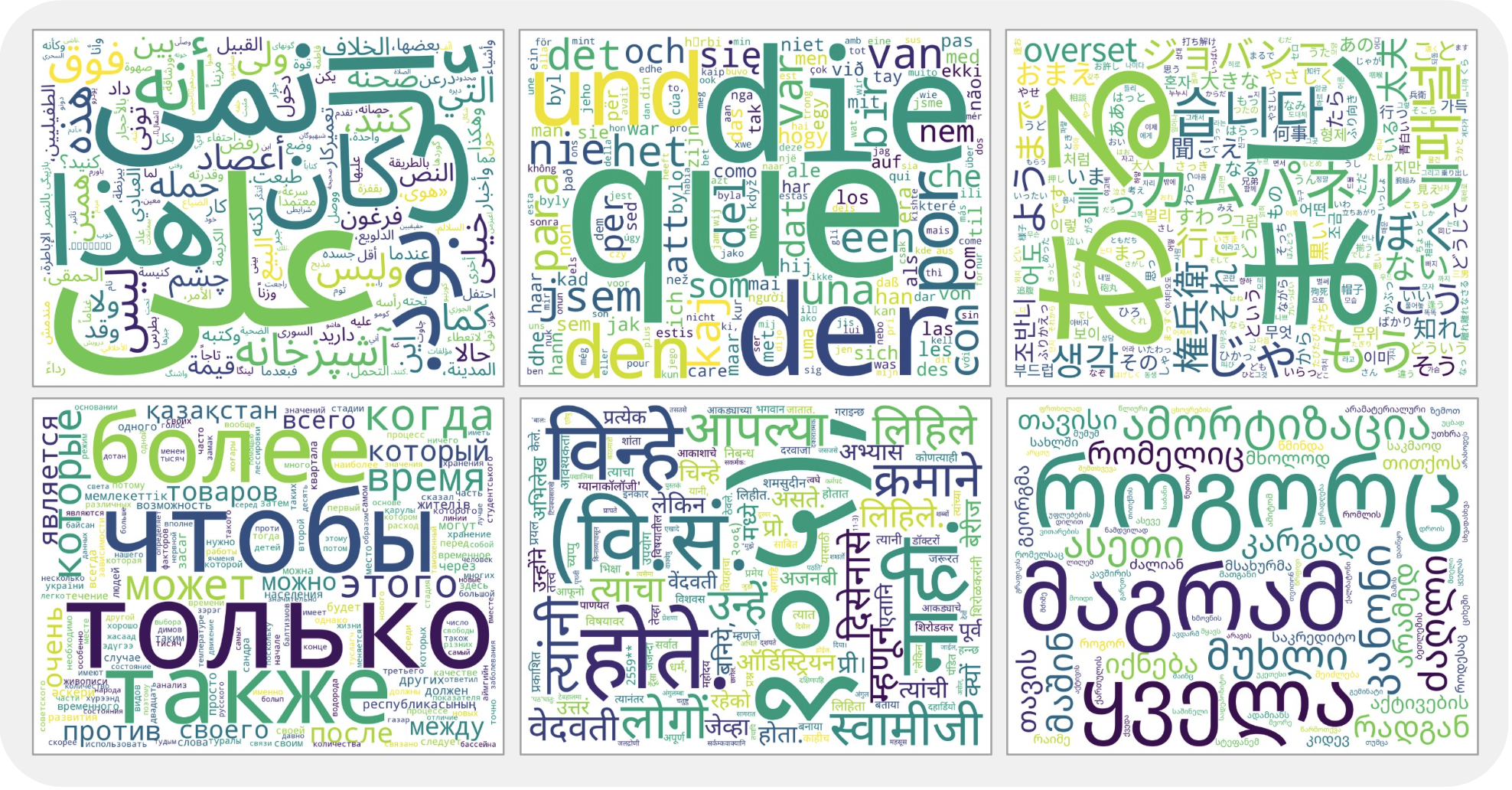
The word clouds summarize frequent tokens across the major script families, offering a quick visual sense of MORE's multilingual content diversity beyond the numeric language counts.
Annotation workflow: Page-wise structure annotation verifies layout boxes and reading-order links. Element-wise content annotation aggregates predictions from multiple OCR/VLM systems, then human experts adopt exact matches, refine errors, and discard ambiguous cases.
conda create -n more python=3.10
conda activate more
pip install -r requirements.txt
MORE follows the OmniDocBench v1.5 evaluation protocol and uses CDM for formula recognition. CDM renders LaTeX before matching visual characters, so formula evaluation requires Ghostscript, TeX Live, and Node.js.
Install Ghostscript and TeX Live:
sudo apt-get update
sudo apt-get install -y ghostscript texlive-full wget
Install Node.js 16.x:
tmp_dir=$(mktemp -d)
cd "$tmp_dir"
wget https://registry.npmmirror.com/-/binary/node/latest-v16.x/node-v16.13.1-linux-x64.tar.gz
tar -xvf node-v16.13.1-linux-x64.tar.gz
sudo mkdir -p /usr/local/nodejs
sudo cp -r node-v16.13.1-linux-x64/* /usr/local/nodejs/
sudo ln -sf /usr/local/nodejs/bin/node /usr/local/bin/node
sudo ln -sf /usr/local/nodejs/bin/npm /usr/local/bin/npm
cd -
Check the required commands:
gs --version
pdflatex --version
node -v
npm -v
Run any config with:
mkdir -p result
python pdf_validation.py --config <config_path>
The repository also includes a small md2md demo with paired ground-truth and prediction Markdown files:
python pdf_validation.py --config configs/md2md.yaml
The runner writes detailed outputs to result/, including per-task matched samples, per-page edit-distance files, CDM artifacts, TEDS scores, and the final metric summary.
result/
  pred_quick_match_metric_result.json
  pred_quick_match_text_block_result.json
  pred_quick_match_display_formula_result.json
  pred_quick_match_table_result.json
  pred_quick_match_reading_order_result.json
If you only want a lightweight text-style smoke test, create a local config from the recognition example below and point it at one of the files under demo_data/recognition/.
MORE supports two common evaluation formats.
The current single-module loader expects ground truth and prediction fields in the same JSON file. Each item contains layout_dets, and every layout item stores the target value plus a prediction field, usually named pred.
[
  {
    "layout_dets": [
      {
        "category_type": "text_block",
        "text": "ground-truth text",
        "pred": "model prediction",
        "attribute": {
          "text_language": "text_english"
        }
      }
    ],
    "page_info": {
      "image_path": "sample.jpg",
      "page_attribute": {}
    },
    "extra": {}
  }
]
Use these ground-truth keys for the provided demos:
| Task | Demo File | Ground-truth Key | Prediction Key | Normalization |
|---|---|---|---|---|
| Text | demo_data/recognition/MORE_demo_paragraph.json |
text |
pred |
text |
| Code | demo_data/recognition/MORE_demo_code.json |
text |
pred |
text |
| Catalog | demo_data/recognition/MORE_demo_catalog.json |
text |
pred |
text |
| Formula | demo_data/recognition/MORE_demo_formula.json |
latex |
pred |
formula |
| Table | demo_data/recognition/MORE_demo_table.json |
html |
pred |
table |
recogition_eval:
  metrics:
    - Edit_dist
  dataset:
    dataset_name: omnidocbench_single_module_dataset
    ground_truth:
      data_path: ./demo_data/recognition/MORE_demo_paragraph.json
      data_key: text
    prediction:
      data_key: pred
    category_type: text
Note:
recogition_evalis intentionally spelled this way to match the current task registry.
For full-page parsing, put matching .md files in ground-truth and prediction folders:
demo_data/md2md/
  gt/
    sample_001.md
  pred/
    sample_001.md
md2md_dataset extracts and matches:
$$...$$, $...$, \[...\], or \(...\)end2end_eval:
metrics:
text_block:
metric:
- Edit_dist
display_formula:
metric:
- Edit_dist
- CDM
table:
metric:
- TEDS
- Edit_dist
reading_order:
metric:
- Edit_dist
dataset:
dataset_name: md2md_dataset
ground_truth:
data_path: ./demo_data/md2md/gt
prediction:
data_path: ./demo_data/md2md/pred
match_method: quick_match
Available match_method values are quick_match, simple_match, and no_split.
The camera-ready evaluation uses task-specific output formats so different model families can be compared fairly.
| Task | Expected Output |
|---|---|
| Text / Catalog | Plain extracted text. |
| Code | Markdown code block. |
| Formula | LaTeX expression. |
| Table | HTML table. |
| End-to-end parsing | Markdown body content in reading order, with tables represented as HTML and formulas represented as LaTeX. Headers and footers are ignored. |
Run any config with:
mkdir -p result
python pdf_validation.py --config <config_path>
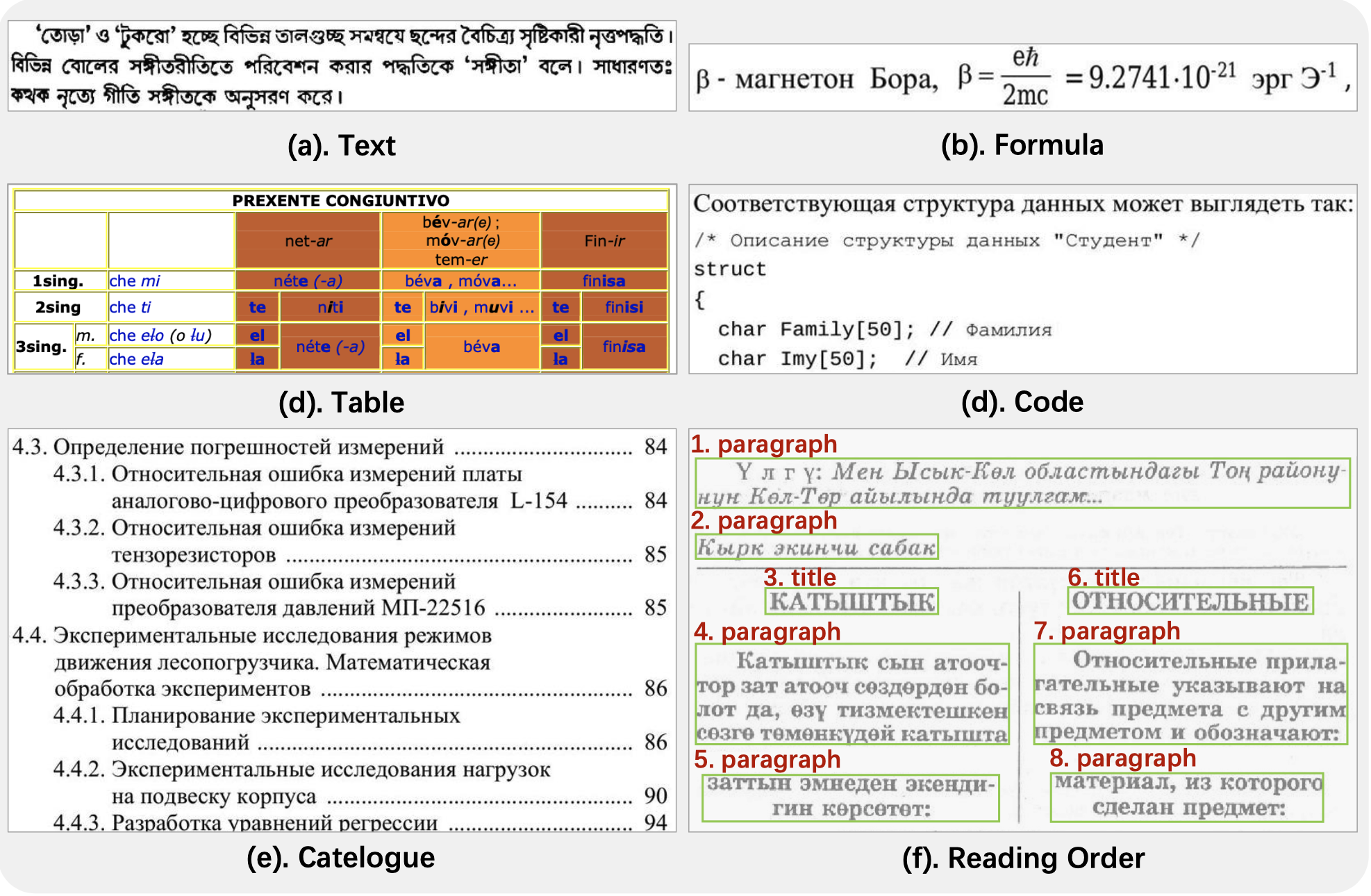
MORE follows the OmniDocBench v1.5 evaluation protocol and extends it to code and catalog evaluation. The final benchmark score is decoupled across tasks so one stage does not silently propagate errors into another.
| Task | Metric | Config Example | Notes |
|---|---|---|---|
| Text | NED | configs/ocr.yaml |
Raw runner output is Edit_dist; leaderboard reports 1 - Edit_dist. |
| Code | NED | custom recognition config | Same JSON shape as text, with code-specific content. |
| Catalog | NED | custom recognition config | Same JSON shape as text. |
| Reading Order | NED | configs/md2md.yaml |
Computed from matched element order. |
| Formula | CDM | configs/formula_recognition.yaml |
Requires LaTeX, Ghostscript, and Node.js. |
| Table | TEDS | configs/table_recognition.yaml |
Evaluates HTML tree similarity. |
Sequential tasks use normalized edit distance:
\begin{aligned}
\mathrm{NED}
&= 1 - \frac{1}{N} \sum_{i=1}^{N}
\frac{\mathrm{EditDist}(P_i, G_i)}
{\max(\lvert P_i\rvert, \lvert G_i\rvert)}
\end{aligned}
Formula recognition uses Character Detection Matching:
\begin{aligned}
\mathrm{CDM}
&= \frac{1}{N} \sum_{i=1}^{N}
\frac{2 \cdot TP_i}{2 \cdot TP_i + FP_i + FN_i}
\end{aligned}
Table recognition uses TEDS:
\begin{aligned}
\mathrm{TEDS}
&= 1 - \frac{1}{N} \sum_{i=1}^{N}
\frac{\mathrm{TreeEditDist}(T_{p,i}, T_{g,i})}
{\max(\lvert T_{p,i}\rvert, \lvert T_{g,i}\rvert)}
\end{aligned}
The overall score is the arithmetic mean of the six task scores:
\begin{aligned}
\mathrm{Overall}
&= \frac{1}{6}
\left(
\mathrm{TEDS}
+ \mathrm{CDM}
+ \sum_{k \in \mathcal{S}} \mathrm{NED}_k
\right)
\end{aligned}
Scores are reported as percentages. Higher is better. The table below lists task-wise averages from the camera-ready paper; page-wise averages are reported in the paper appendix.
| Model | Size | Overall ↑ | Text NED ↑ | Formula CDM ↑ | Table TEDS ↑ | Code NED ↑ | Catalog NED ↑ | Read Order NED ↑ |
|---|---|---|---|---|---|---|---|---|
| HunyuanOCR | 1B | 92.42 | 93.81 | 93.28 | 78.56 | 97.07 | 95.36 | 96.45 |
| Gemini 3 | - | 91.61 | 95.39 | 90.27 | 81.02 | 93.05 | 94.31 | 95.63 |
| PaddleOCR-VL | 0.9B | 87.96 | 90.99 | 91.11 | 61.11 | 96.29 | 93.04 | 95.19 |
| dots.ocr | 3B | 84.31 | 94.45 | 90.77 | 39.81 | 95.38 | 88.26 | 97.18 |
| Qwen2.5-VL | 3B | 83.93 | 89.36 | 84.48 | 68.27 | 86.69 | 92.54 | 82.23 |
| Qwen3-VL | 2B | 83.56 | 92.02 | 65.45 | 65.21 | 92.38 | 93.76 | 92.53 |
| DeepSeekOCR | 3B-A570M | 82.91 | 85.27 | 75.67 | 61.63 | 92.26 | 88.26 | 94.36 |
| MinerU2.5 | 1.2B | 48.85 | 27.12 | 73.29 | 33.83 | 72.41 | 21.61 | 64.81 |
Key observations from the paper:
MORE/
  assets/                 README figures
  configs/                evaluation configs
  dataset/                dataset loaders
  demo_data/              small recognition and md2md demos
  metrics/                Edit distance, TEDS, CDM, and reporting utilities
  registry/               task, dataset, and metric registries
  task/                   evaluation task wrappers
  tools/                  visualization, conversion, and model inference scripts
  utils/                  matching, extraction, normalization, and IO helpers
  pdf_validation.py       config-driven evaluation entry point
The scripts under tools/model_infer/ are adapters for generating predictions from OCR or document parsing models. They are not called automatically by pdf_validation.py; run or adapt them first, then evaluate the generated predictions with a config file.
FileNotFoundError under result/: create the output directory with mkdir -p result before running the evaluator.Cannot find pred for ...: make sure prediction filenames match the ground-truth filenames for md2md, or that every JSON layout item has the configured prediction key.ground_truth.data_key, prediction.data_key, category_filter, and category_type in the config.MORE includes materials derived from collected document resources and community contributions. We have made reasonable efforts to exclude materials that should not be redistributed. The released data and evaluation resources are intended for academic research and benchmark evaluation only, and should not be used for commercial purposes. If you are a rights holder and have concerns about any included content, please contact bing-hong.wu@foxmail.com; we will review the request and take appropriate action.
We sincerely hope MORE is useful for your research. If it helps your work, we would be grateful if you could cite our paper. Please replace the venue metadata with the official proceedings entry once it is available.
@inproceedings{xu2026more,
  title = {MORE: A Multilingual Document Parsing Benchmark and Evaluation},
  author = {Long Xu and Binghong Wu and Tinghao Yu and Hao Feng and Zhenyu Huang and Haoqing Jiang and Yunhao Wang and Shuo Huang and Feng Zhang},
  booktitle = {International Conference on Machine Learning},
  year = {2026}
}